Understanding w/c Ratio and Why It Matters
What is the water-cement ratio?
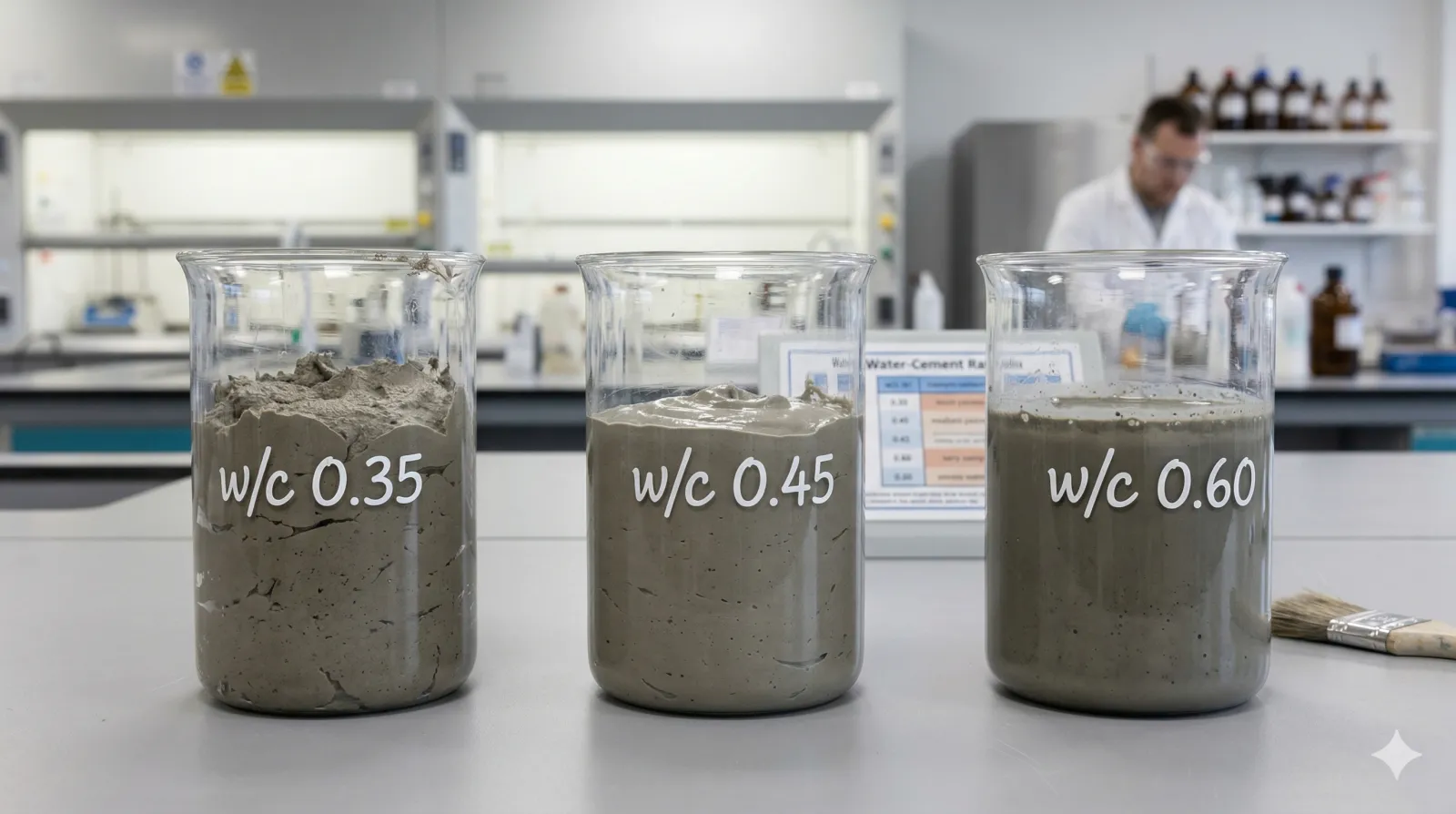
The water-cement ratio (w/c) is exactly what it sounds like: the mass of water divided by the mass of cement in a concrete mix.
w/c = mass of water / mass of cement
A mix with 180 kg of water and 360 kg of cement has a w/c of 0.50. Simple enough. But this single number has more influence on the final properties of your concrete than almost any other variable.
Why it matters so much
When cement reacts with water (hydration), it forms calcium silicate hydrate (C-S-H) gel — the "glue" that holds concrete together. The w/c ratio determines how much space is left over after hydration.
At a w/c of about 0.38, there's theoretically just enough water to fully hydrate all the cement. Below this, some cement particles never hydrate. Above this, excess water that isn't consumed by hydration remains in the paste as capillary pores.
Those capillary pores are the problem. They reduce strength, increase permeability, and make the concrete vulnerable to freeze-thaw damage, chloride ingress, and carbonation. More water means more pores means weaker, less durable concrete.
This is why the w/c ratio is arguably the single most important number in mix design.
Abrams' law
In 1918, Duff Abrams published one of the most important findings in concrete technology. He demonstrated that concrete strength is inversely related to the w/c ratio, following an approximately exponential relationship:
f'c = A / B^(w/c)
Where A and B are constants that depend on the age of the concrete, the cement type, and curing conditions. The exact constants don't matter for practical purposes. What matters is the shape of the curve: as w/c goes up, strength drops rapidly.
Some approximate 28-day compressive strengths for OPC concrete (properly cured):
| w/c ratio | Approx. 28-day strength (MPa) | |-----------|-------------------------------| | 0.40 | 45–50 | | 0.45 | 38–43 | | 0.50 | 30–37 | | 0.55 | 25–30 | | 0.60 | 20–25 | | 0.65 | 15–20 |
These are indicative values. Actual strengths depend on cement type, aggregate quality, admixtures, and curing. But the trend is clear and consistent: lower w/c means higher strength.
Typical ranges for different applications
Different applications demand different w/c ratios, driven by strength requirements and durability exposure classes.
High-performance structural concrete (w/c 0.30–0.40): Precast elements, prestressed beams, bridge decks. Requires superplasticisers to achieve workability at such low water contents. Strengths of 50–80+ MPa.
General structural concrete (w/c 0.40–0.55): Most reinforced concrete frames, slabs, and foundations. The sweet spot for most building projects. Strengths of 25–50 MPa.
Mass concrete and non-structural (w/c 0.55–0.65): Blinding layers, mass fill, unreinforced bases. Where strength requirements are modest and heat of hydration is a concern. Strengths of 15–25 MPa.
Anything above w/c 0.65 is generally poor practice for structural work. The resulting concrete will be porous, weak, and prone to durability problems.
w/c ratio and durability
Strength gets all the attention, but durability is often the governing criterion. Standards like EN 206 and ACI 318 specify maximum w/c ratios based on exposure class, not just strength requirements.
For example, under EN 206:
- XC1 (dry interior): max w/c = 0.65
- XC3/XC4 (moderate humidity, cyclic wetting): max w/c = 0.55
- XD2 (chlorides, wet/rarely dry): max w/c = 0.50 or lower
- XS3 (tidal/splash zones): max w/c = 0.45
Even if a lower-strength concrete would satisfy the structural design, the exposure class may force you to use a lower w/c ratio to ensure the concrete lasts its intended service life.
The workability trade-off
Lower w/c ratios produce stronger, more durable concrete. So why not just use the lowest w/c possible? Because workability.
Water makes concrete flow. Reduce the water and the mix becomes stiff, hard to place, hard to compact, and prone to honeycombing. There's no point designing a w/c 0.35 mix if the site crew can't place it properly — poorly compacted high-strength concrete will underperform well-compacted normal-strength concrete every time.
The solution is chemical admixtures. Water-reducing admixtures (plasticisers) and high-range water reducers (superplasticisers) allow you to reduce water content while maintaining workability. A superplasticiser can reduce water demand by 20–30%, letting you achieve a w/c of 0.35 with the same slump as a w/c 0.50 mix without admixtures.
Modern concrete practice is essentially the art of achieving low w/c ratios at usable workabilities.
Free water vs total water
A subtlety that catches people out: the w/c ratio should be calculated using the free water content, not the total water in the mix.
Aggregates absorb water. If your coarse aggregate has a water absorption of 1.5% and you're using 1000 kg of it, roughly 15 kg of your mixing water will be absorbed into the aggregate pores and won't be available for cement hydration.
Free water = total water − water absorbed by aggregates + surface moisture on aggregates
When aggregates arrive on site wet (which they usually do), the surface moisture adds to the free water. When they're dry, they steal water from the mix. Either way, you need to adjust.
This is why mix designs specify free water content, and why moisture testing of aggregates is essential for quality control. A 2% error in aggregate moisture measurement on a large batch can shift your effective w/c by 0.02–0.03 — enough to move you outside specification.
How to measure w/c ratio on site
For ready-mix concrete, the w/c ratio is controlled at the batching plant. But how do you verify it on site?
Delivery ticket: Every load should come with a batch ticket showing the actual proportions. Check it against the specified mix.
Slump test: Not a direct measure of w/c, but a sudden increase in slump compared to previous loads suggests water has been added. Be suspicious.
Microwave oven method (BS 1881-128): A sample is weighed, dried in a microwave, and reweighed. The water content can be calculated and, if the cement content is known, the w/c estimated. It's approximate but useful.
The "no water added on site" rule: The most important quality control measure is ensuring that nobody adds water to the truck on site. It's tempting when the concrete arrives stiff, but adding 20 litres of water to a 6 m³ load raises the w/c by about 0.01 — and that's cumulative with every litre.
Practical takeaways
- Know your target w/c before ordering or designing a mix. It should come from either the structural design (strength) or the exposure class (durability) — whichever governs.
- Use admixtures to achieve workability rather than adding water.
- Account for aggregate moisture when batching. Free water is what matters.
- Never add water on site to improve workability. Use a superplasticiser instead.
- Check batch tickets on every load.
Use our strength predictor to see exactly how w/c ratio affects your expected strength, or try the mix ratio calculator to design a mix with the right w/c for your application.