What is Characteristic Strength? EN 206 Simplified
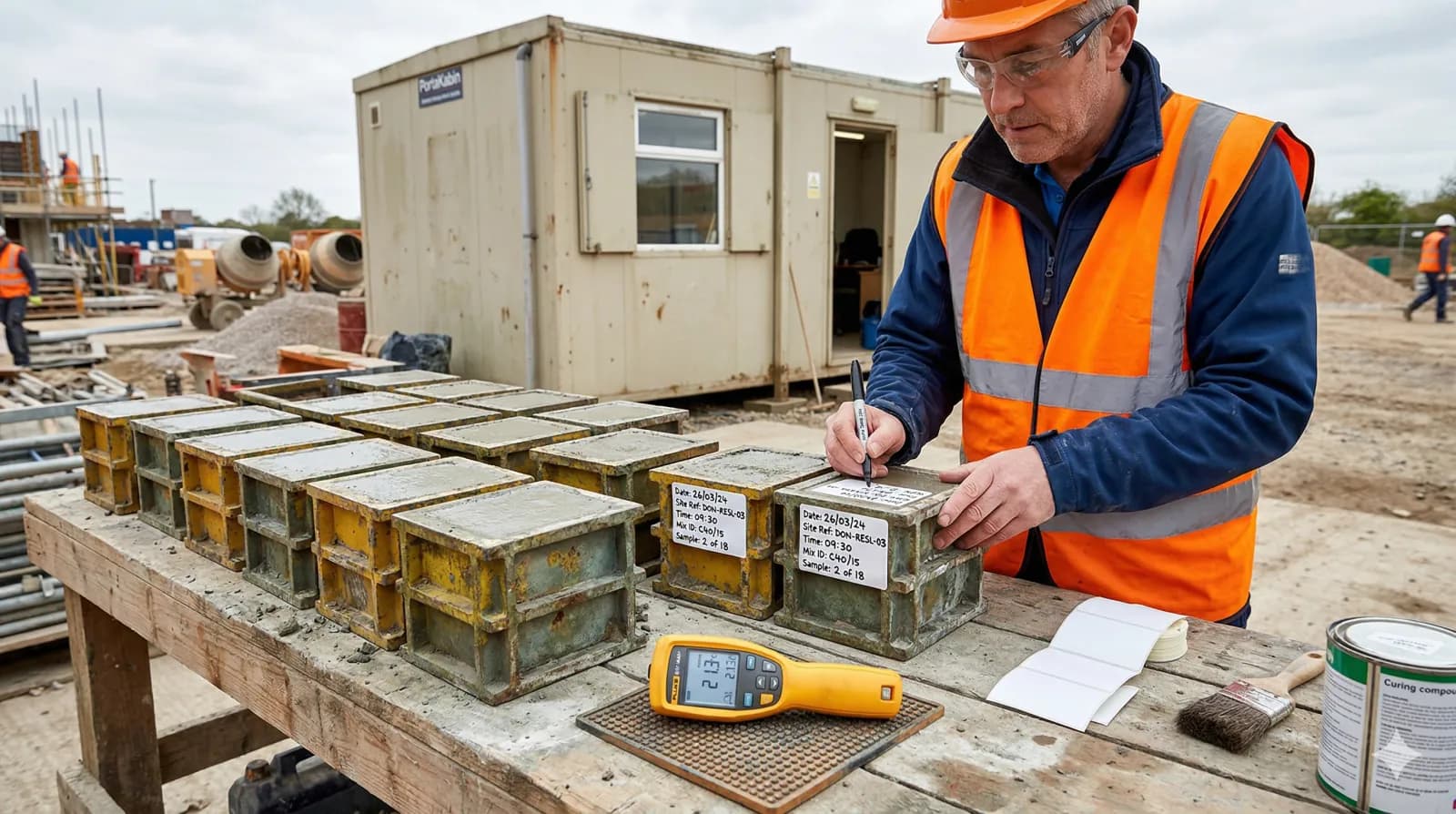
The problem with averages
Suppose your concrete has an average cube strength of 35 MPa. Sounds fine for a C30/37 mix. But what about the weak batches? If your standard deviation is 6 MPa, roughly 20% of your cubes will fall below 30 MPa. Design a structure around the average and you're gambling that the critical section didn't receive one of the weaker batches.
Structural engineers don't like gambling. They want a strength value they can rely on — one that accounts for the inherent variability in concrete production. That value is the characteristic strength.
The statistical definition
The characteristic strength (f_ck) is defined as the value below which no more than 5% of all possible strength measurements are expected to fall. It's the 5th percentile of the strength distribution.
If concrete strength follows a normal distribution (which it approximately does, given consistent production), then:
f_ck = f_m − 1.645 × s
Where:
- f_ck = characteristic compressive strength (MPa)
- f_m = mean compressive strength (MPa)
- 1.645 = the z-value for 5% probability in one tail of the normal distribution
- s = standard deviation of the strength results (MPa)
The number 1.645 is not arbitrary. From normal distribution tables, the area under the curve below the mean minus 1.645 standard deviations is exactly 5%. This is a deliberate statistical choice: we accept that 1 in 20 test results may fall below the characteristic value, because other safety factors in the design process (partial safety factors on loads and materials) provide additional protection.
Rearranging: the target mean strength
In mix design, you work the equation in reverse. You know the required characteristic strength (from the structural engineer's specification) and you need to find the mean strength to target:
f_m = f_ck + 1.645 × s
This is called the margin or current margin. It's the extra strength you must build into the mix to account for variability.
Example 1: C25/30, well-controlled production (s = 4 MPa):
f_m = 25 + 1.645 × 4 = 25 + 6.6 = 31.6 MPa
Example 2: C25/30, poorly controlled production (s = 8 MPa):
f_m = 25 + 1.645 × 8 = 25 + 13.2 = 38.2 MPa
The second producer needs to target 38.2 MPa just to achieve the same characteristic strength. That means more cement, more cost, and more CO₂. Quality control isn't just about compliance — it's an economic imperative.
The EN 206 strength classes
EN 206 (the European standard for concrete specification) defines strength classes using two numbers:
C_cylinder / C_cube
For example, C30/37 means:
- Characteristic cylinder strength (150 × 300 mm) = 30 MPa
- Characteristic cube strength (150 mm) = 37 MPa
Cylinder strengths are lower than cube strengths for the same concrete because of the different failure modes. The ratio is typically around 0.80–0.85. Eurocode 2 (the structural design code) uses cylinder strength, while UK practice has historically used cube strength. The dual notation in EN 206 bridges the two traditions.
Common strength classes and their typical applications:
| Class | f_ck,cyl (MPa) | f_ck,cube (MPa) | Typical use | |-------|----------------|-----------------|-------------| | C16/20 | 16 | 20 | Strip footings, blinding | | C25/30 | 25 | 30 | General structural, slabs | | C30/37 | 30 | 37 | Frames, RC beams | | C40/50 | 40 | 50 | Prestressed, high-rise | | C50/60 | 50 | 60 | Bridges, precast |
Conformity criteria: how compliance is assessed
Specifying C30/37 doesn't mean every single cube must hit 37 MPa. EN 206 defines two conformity criteria (for initial and continuous production):
Criterion 1 (mean of n results):
Mean of n consecutive results ≥ f_ck + 4 (for continuous production with ≥ 35 results)
Criterion 2 (individual result):
Any individual result ≥ f_ck − 4
Both criteria must be satisfied simultaneously.
So for C30/37 (cube), the mean of a group of consecutive results must be at least 41 MPa, and no single result can fall below 33 MPa.
This dual criterion is clever: Criterion 1 catches a general drift downward in quality, while Criterion 2 catches isolated rogue results.
Why the standard deviation matters so much
The margin (1.645 × s) is directly proportional to the standard deviation. This means that quality control — as measured by consistency — has a direct financial impact.
Consider a producer making C30/37 concrete:
| Standard deviation | Target mean (cube) | Extra cement (approx.) | |---|---|---| | 3 MPa | 41.9 MPa | Baseline | | 5 MPa | 45.2 MPa | +15 kg/m³ | | 8 MPa | 50.2 MPa | +40 kg/m³ |
At s = 8 MPa, you're using roughly 40 kg/m³ more cement than a well-controlled plant — on a 10,000 m³ project, that's 400 tonnes of extra cement. At £100–120 per tonne, that's £40,000–48,000 in wasted material alone.
The best concrete plants achieve standard deviations of 3–4 MPa through rigorous control of aggregate moisture, accurate batching, and consistent raw materials. It's not glamorous work, but it pays for itself many times over.
Partial safety factors: the bigger picture
Characteristic strength is just one layer in the hierarchy of structural safety. Eurocode 2 applies additional partial safety factors:
- γ_c = 1.50 for concrete (the material safety factor)
- γ_f = variable for loads (1.35 for permanent, 1.50 for variable)
The design concrete strength is:
f_cd = f_ck / γ_c = f_ck / 1.50
So for C30/37, the design cylinder strength is 30 / 1.50 = 20 MPa. The structural engineer sizes members using this reduced value.
The chain of safety is:
- Concrete is produced to a target mean strength (f_m) with a margin above characteristic
- The characteristic strength (f_ck) is the 5th percentile — 95% of concrete exceeds this
- The design strength (f_cd) is further reduced by a factor of 1.50
- Loads are factored upward
Each step adds a layer of conservatism. The result is a system where actual structural failure requires multiple simultaneous worst-case events — which is why concrete building collapses due to material strength are extremely rare.
Practical implications
For specifiers: Don't over-specify strength class. Every step up costs more cement and generates more CO₂. If the structure needs C25/30, don't write C32/40 "just to be safe" — the safety factors are already in the system.
For producers: Invest in quality control. Reducing your standard deviation from 6 to 4 MPa saves more money than almost any other operational improvement.
For site engineers: Understand that individual cube results below the characteristic strength don't necessarily mean non-compliance. It's the conformity criteria (mean and minimum) that determine compliance, not individual results.
For everyone: The characteristic strength is a statistical concept. It only makes sense in the context of a population of results. A single cube test doesn't tell you the characteristic strength — it's one data point from a distribution.
Explore how variability affects your design requirements with our strength predictor.